Regulatory compliance

Meet climate risk regulations with clarity, confidence, and consistency.

Alpha-Klima helps institutions navigate complex climate and sustainability regulations by translating regulatory requirements into structured, auditable, and decision-ready outputs aligned with leading frameworks.

What it solves

Regulatory alignment

Ensure consistency with key climate and sustainability regulations, including CSRD, EU Taxonomy, and banking supervisory expectations.

Reporting complexity

Simplify complex regulatory requirements by converting data, models, and scenarios into clear, standardized disclosures.

Audit & supervision readiness

Reduce regulatory risk by delivering transparent, traceable outputs designed for supervisory review and external audits.

What you get

Regulation-ready framework

A structured approach that maps climate risk data and metrics directly to regulatory requirements and reporting standards.

Standardized disclosures

Generate consistent, comparable disclosures aligned with regulatory templates and supervisory guidance.

Traceability & documentation

Full transparency from data sources to final outputs, supporting internal controls and audit processes.

Cross-functional alignment

Bridge risk, finance, sustainability, and compliance teams with a single, coherent regulatory view.
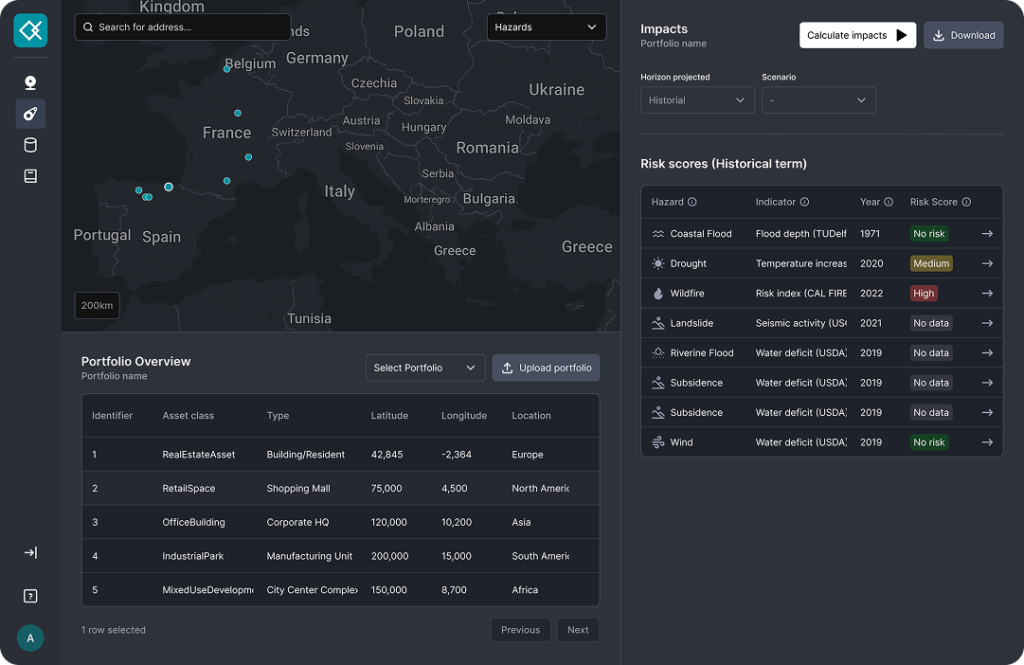
Climate risk analysis dashboard showing hazard impacts, risk scores and asset portfolio across Europe

Engineered to Meet the Highest Standards

Frameworks

Built to support evolving regulatory frameworks, translating climate risk analysis into compliant disclosures and supervisory-ready documentation.

Controls

Robust internal controls and validation processes ensure consistency, accuracy, and regulatory alignment across climate risk analyses and disclosures.

Auditability

End-to-end traceability from source data to reported outputs enables efficient audits, supervisory review, and full methodological transparency.

Governance

Clear ownership, documented methodologies, and defined responsibilities support strong regulatory governance and accountability across teams.

Evolution of the EU Regulatory Framework

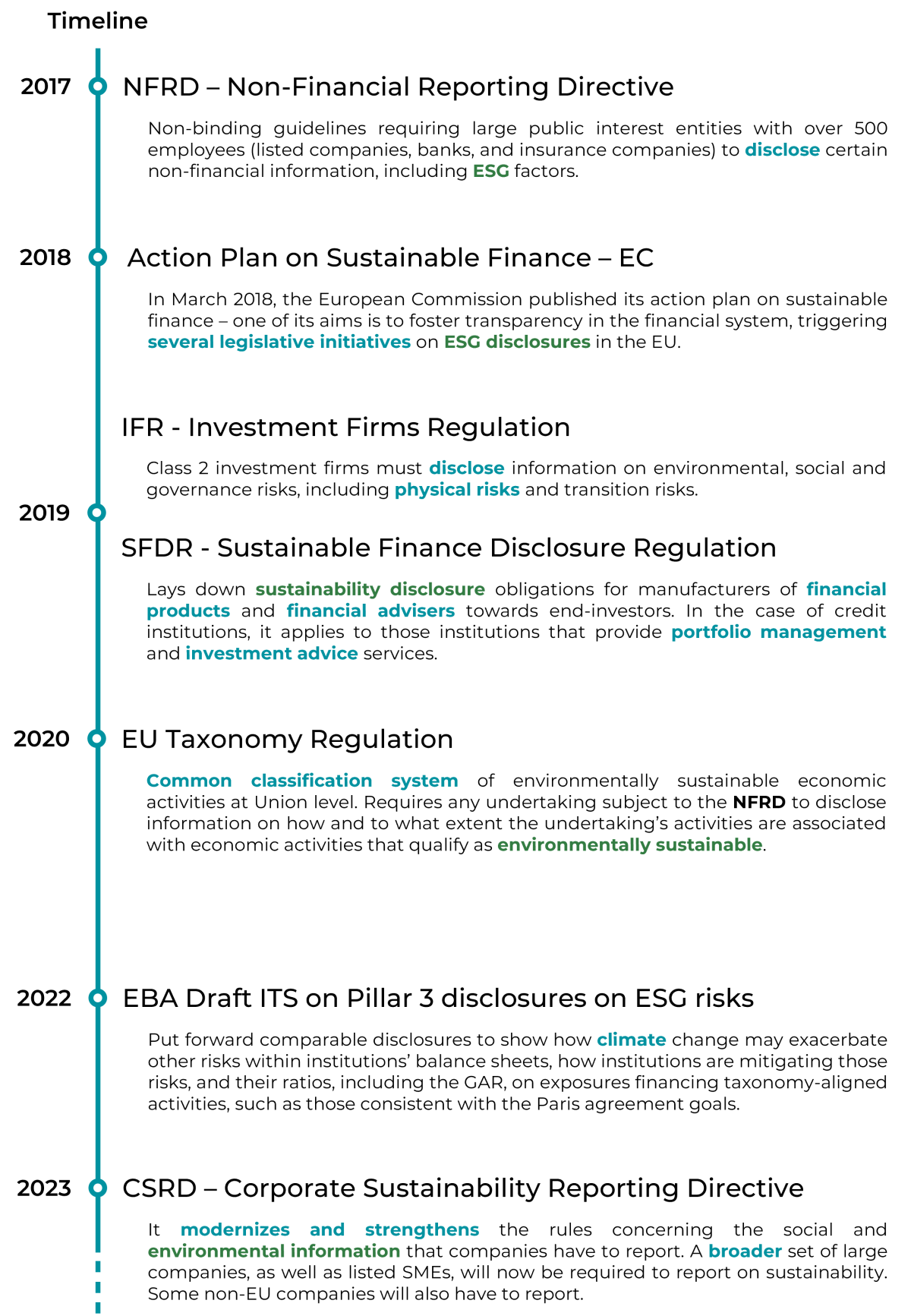
The European Union has recognized the critical need for robust climate risk assessment and effective adaptation strategies. In March 2018, the European Commission published an Action Plan to foster a sustainable financial system, with a strong emphasis on integrating Environmental, Social, and Governance (ESG) guidelines. The Plan aims to integrate sustainability into risk management and enhance transparency on sustainability-related issues, requiring new reporting obligations and data collection efforts. Strengthening resilience and reducing vulnerability to climate change are also key components of the European Climate Law and the EU Strategy on Adaptation to Climate Change.
Overarching Goals

  • Achieving the Paris Agreement goals in the EU by aligning regulations with climate targets.
  • Disclosing climate change risks to support mitigation and adaptation efforts.
  • Standardizing ESG reporting for consistency and comparability.
  • Promoting investment in sustainable businesses and sectors to drive long-term environmental benefits.
  • Preventing green-washing through stringent verification and transparency measures.
EU climate-finance regulatory framework timeline (2018-2026)
EU regulatory framework timeline (2018-2026)

EBA — Pillar 3 Disclosures on ESG Risks

Commission Implementing Regulation (EU) 2022/2453

Who is affected?

Most banks subject to the EU’s CRD IV/CRR. Including large EU institutions under the supervision of the ECB, or those with securities traded on a regulated market of any EU member state.

“Large” = any bank with assets exceeding €30 billion.

What do they need to disclose?

  1. Quantitative Information on Climate Change Physical Risk
    Institutions must disclose their exposures to sectors and geographies that may be negatively impacted by climate change events linked to physical risks, including:
    • Acute risks: floods, storms, wildfires, etc.
    • Chronic risks: rising sea levels, prolonged droughts, etc.

    Template 5 provides information on exposures in the banking book (loans and advances, debt securities and equity instruments not held for trading and not held for sale) towards non-financial corporates, on loans collateralised with immovable property and on repossessed real estate collateral. These exposures are segregated by:

    • Sector of economic activity (NACE classification)
    • Geography (specifically for those materially exposed to acute and chronic events)
    • Maturity buckets
  2. Energy Performance and Real Estate
    For real estate-related loans, institutions must disclose the energy performance of the underlying real estate collateral. This includes the distribution of real estate loans by Energy Performance Certificate (EPC) labels and energy consumption figures.
  3. Mitigation Actions
    Quantitative information on actions taken to mitigate physical risks, including investment in taxonomy-aligned activities like climate change adaptation actions (e.g. flood protection measures).
  4. Qualitative Information
    Explanations regarding risk management strategies, governance, and processes for identifying, monitoring, and managing physical risks. Includes the narrative accompanying Template 5 on the sources of information and methodologies used.

CSRD — Corporate Sustainability Reporting Directive

Commission Delegated Regulation (EU) 2023/2772 — see also the Q&A on the Adoption of ESRS

Who is affected?

  • EU-based large undertakings (2 of 3 criteria on consecutive balance sheet dates): total assets > €25 million; annual net turnover > €50 million; ≥ 250 employees on average.
  • EU-based parent of a group that meets the above as a whole.
  • SMEs with listed securities on any EU-regulated market (2 of 3): assets > €450k, turnover > €900k, ≥ 10 employees.
  • Third-country undertakings (incl. US) with > €150M EU turnover and at least one of: subsidiary that qualifies as large undertaking, subsidiary with listed securities, or significant EU branch with turnover > €40M.

Reporting Phase-in

Entity TypeFiscal YearStarts Reporting in
Entities already subject to NFRD (large listed companies, large banks and large insurance undertakings — all if > 500 employees)20242025
Large undertakings* not currently subject to NFRD20252026
SMEs with listed securities (excluding micro-undertakings*)20262027
Third-country undertakings*20282029

* see “Who is affected” criteria above.

What do they need to disclose?

The European Sustainability Reporting Standards (ESRS) are mandatory for use by companies obliged by the Accounting Directive to report sustainability information. The Accounting Directive, as amended by the CSRD in 2022, ensures companies across the EU report comparable and reliable sustainability information.

The ESRS take a double materiality perspective — companies must report both:

  • on their impacts on people and the environment (impact materiality)
  • on how social and environmental issues create financial risks and opportunities for the company (financial materiality)

Out of the 12 topical ESRS proposed by EFRAG, the European Commission has decided that all reporting requirements should be subject to materiality, with the exception of ESRS 2 — General Disclosures. This includes also ESRS E1 — Climate Change.

Materiality assessment methodology (4 steps)

  1. Impact Materiality
    A sustainability matter is material from an impact perspective when it pertains to the undertaking’s material actual or potential, positive or negative impacts on people or the environment over the short-, medium- or long-term. Severity is examined via:
    • Scale: how grave the impact is.
    • Scope: how widespread the impact is.
    • Irremediable Character: extent to which the impact can be mitigated or reversed.
  2. Financial Materiality
    A sustainability matter is material from a financial perspective if it triggers (or could reasonably be expected to trigger) material financial effects on the undertaking. Likelihood and magnitude evaluated over short-, medium-, long-term horizons. E.g. impacts on revenue from assets affected by extreme weather, or higher insurance costs.
  3. Use of Scenario Analysis
    Companies should employ scenario analysis (IPCC, NGFS) to estimate the financial implications of physical risks on assets, operations, and supply chain.
  4. Stakeholder Engagement and Sector Relevance
    Engage stakeholders and evaluate how physical risks align with sector-specific sensitivities — dependencies on natural resources, geographic location, exposure to climate-sensitive areas.

ESRS 2 disclosure requirements

  • ESRS 2 IRO-1 — Description of the processes to identify and assess material climate-related impacts, risks and opportunities. Must include identification of climate-related hazards (at least high emission scenarios) and assessment of how assets and business activities are exposed and sensitive to those hazards.
  • ESRS 2 SBM-3 — Material impacts, risks and opportunities and their interaction with strategy and business model. Must describe resilience of strategy and business model in relation to climate change, including scope, methodology and results of resilience analysis using scenario analysis.

ESRS E1 disclosure requirements

  • ESRS E1-4 — Targets related to climate change mitigation and adaptation. Disclose climate-related targets, including those for energy efficiency, climate change adaptation, or physical risk mitigation.
  • ESRS E1-9 — Anticipated financial effects from material physical risks and potential climate-related opportunities. Must include:
    • Monetary amount and proportion (%) of assets at material physical risk over short-, medium- and long-term, before adaptation actions, disaggregated by acute and chronic risk.
    • Proportion of assets at material physical risk addressed by climate change adaptation actions.
    • Location of significant assets at material physical risk.
    • Monetary amount and proportion (%) of net revenue from business activities at material physical risk over short-, medium- and long-term.
    • Reconciliations to relevant line items in the financial statements.

ESRS E1-9 is consistent with Commission Implementing Regulation (EU) 2022/2453 — Template 5 discussed in Pillar 3 above.

Example: Physical Climate Risk Materiality Assessment

Company Profile: GreenBuild Corp

  • Industry: Real Estate Development and Management.
  • Geographic Scope: Assets located in coastal areas of Europe and Southeast Asia.
  • Asset Types: High-rise office buildings, retail complexes, and residential properties.

Materiality Assessment Framework

StepComponentDescriptionExample assessment
1Identify Potential Physical RisksUse data on extreme weather, climate projections, and asset locations to identify high-risk areas.Coastal assets identified as vulnerable to sea-level rise and tropical storms.
2Assess Impact MaterialityEvaluate if physical risks could significantly affect people or the environment (scale, scope, irremediable character).Scale: 20% of assets in high-impact zones. Scope: tenant displacement and major environmental repair costs. Irremediable Character: High (flood-prone areas may incur unrecoverable damages).
3Assess Financial MaterialityQuantitatively model financial impacts: lost revenue, repair costs, insurance premiums.Estimated repair costs for flooding: €10M/year. Projected insurance premium increase: 15% over 5 years. Scenario (2 °C warming): 10% reduction in asset value.
4Scenario AnalysisTest physical risk impacts under 1.5 °C, 2 °C, or 4 °C warming.Under 2 °C, projected annual revenue at risk: €8M.
5Stakeholder Impact and EngagementIdentify stakeholders impacted: tenants, investors, regulators.High concern from tenants on asset reliability — additional disclosures and adaptation investments required.

Conclusion

GreenBuild Corp determines physical climate risks are material due to:

  • High asset exposure in vulnerable locations.
  • Significant anticipated financial impacts on cash flow and asset valuation.
  • Elevated stakeholder interest in risk mitigation and climate adaptation.

Disclosures

GreenBuild Corp would report:

  • Quantitative Impacts: projected costs for adaptation and repairs, expected loss in asset value, increased insurance costs.
  • Qualitative Insights: strategies for resilience, scenario analysis findings, stakeholder engagement.

Need help with compliance?

Get in touch with our team — we deliver Pillar 3 Template 5 and CSRD ESRS E1-9 outputs end-to-end, with audit-ready documentation.