Research | JUNE 2026
Extreme Heat as a Systemic Climate Risk: Lessons from Europe’s June 2026 Heatwave

Extreme heat is becoming a systemic climate risk in Europe, affecting mortality, energy systems, agriculture, transport and labour productivity. Its impacts depend not only on temperature, but also on humidity, local conditions and the vulnerability of exposed populations and assets.
Key insights
- Heat is becoming a more frequent, intense and widespread climate risk across the continent.
- Extreme heat is Europe's deadliest climate hazard
- Heat waves are already affecting energy systems, agriculture, transportation and labour productivity
Europe Under Heat Stress
Extreme heat is rapidly emerging as one of the most consequential physical climate risks in Europe. Unlike floods, storms or wildfires, heatwaves rarely leave visible damage to buildings or infrastructure. Instead, their impacts are expressed through increased mortality and morbidity, reduced labour productivity, stress on power systems, lower agricultural yields, deteriorating air quality and rising energy demand. As a result, extreme heat is often less visible in traditional assessments of physical damage, yet it represents one of the most pervasive and costly climate hazards from both a societal and risk management perspective. Indeed, heatwaves are estimated to cause more annual fatalities across Europe than all other climate-related hazards combined.
The European heatwave of June 2026 provided a stark illustration of this growing risk. According to a rapid attribution study by World Weather Attribution (WWA), nearly half of Europe’s 854 largest cities experienced their highest levels of heat stress on record during the event. Rather than considering air temperature alone, the study assessed heat stress using the Wet-Bulb Globe Temperature (WBGT), an index that combines temperature, humidity, solar radiation and wind speed to better represent the physiological stress experienced by the human body. The analysis concludes that climate change has substantially increased both the likelihood and intensity of this event. In particular, daytime temperatures during the June 2026 heatwave were estimated to be approximately 3.5°C higher than an equivalent event would have been in 1976, while night-time temperatures were around 2.4°C warmer. Even compared with the exceptional European heatwave of 2003, daytime temperatures were about 2°C higher, with nights remaining approximately 1.3°C warmer. These findings highlight not only the increasing intensity of extreme heat events, but also the growing importance of persistently high night-time temperatures, which limit physiological recovery and substantially increase health risks.
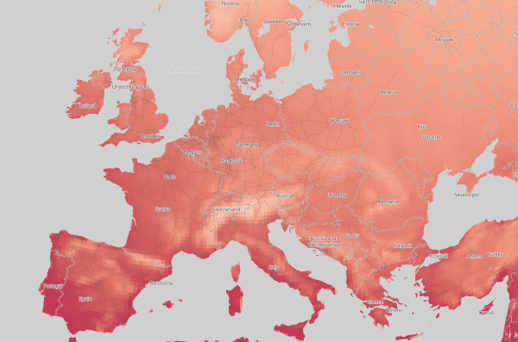
Following figure illustrates the temperature anomalies observed across Europe during the June 2026 heatwave, highlighting the exceptional spatial extent of the event.
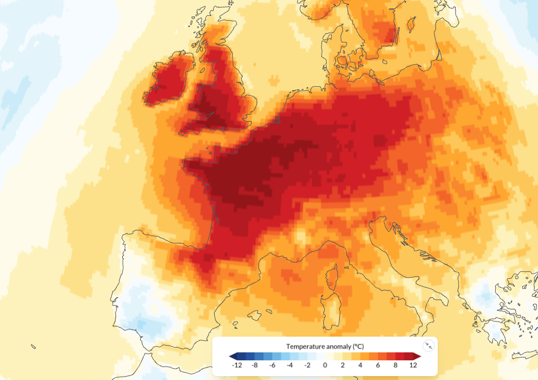
The heatwave was accompanied by an unprecedented series of national temperature records across Europe. The United Kingdom recorded its highest temperature ever observed in June (38.7°C in Somerset), while France experienced its hottest day on record in mainland territory, with temperatures exceeding 40°C in several cities and Paris reaching 40.3°C. Night-time conditions were equally remarkable, with the French capital recording a minimum temperature of 27°C, offering little opportunity for overnight cooling. Germany registered the warmest night in its observational record, with a minimum temperature of 29.4°C in Kubschütz, while Vienna exceeded 40°C for the first time since instrumental records began. Together, these records illustrate that the June 2026 heatwave was not a collection of isolated national extremes, but a continent-wide event affecting millions of people under exceptionally severe thermal conditions.
Heat, health and vulnerability
Heatwaves are not a single-risk phenomenon. Their impacts emerge through several connected channels. Among all the impacts associated with extreme heat, the effect on mortality remains the most significant and best documented.
Exposure to high temperatures places considerable stress on the human body. As ambient temperatures rise, the body’s ability to regulate its internal temperature becomes progressively less effective, increasing the risk of dehydration, heat exhaustion, heatstroke, cardiovascular complications and respiratory distress. Sustained exposure can also exacerbate pre-existing chronic diseases, particularly cardiovascular, renal and respiratory conditions, making heatwaves one of the deadliest climate-related hazards in Europe.
The June 2026 European heatwave provided a clear illustration of these vulnerabilities. In France, preliminary estimates from public health authorities indicated approximately 1,000 excess deaths between 24 and 26 June alone, with around 85% occurring among people aged 65 years or older. The Paris metropolitan area was particularly affected, with a significant increase in deaths occurring at home and temporary pressure on funeral services. In Spain, the Sistema de Monitorización de la Mortalidad (MoMo), a mortality monitoring system operated by the Instituto de Salud Carlos III, attributed more than 1,000 deaths during June to high temperatures.
Recent evidence suggests that these episodes are becoming both more frequent and more severe. According to the report “Calor extremo, salud en Riesgo”, published by the Instituto de Salud Global de Barcelona (ISGlobal), heat stress has already become the most important climate-related health risk in Spain. The report concludes that heat-related mortality increases a 35% for each 1º temperature raise and warns that, under current climate projections, Spain could experience up to eight heatwaves per year by 2050. It also projects a substantial increase in the frequency of tropical nights which prevent the human body from recovering after daytime heat exposure and have been consistently associated with higher mortality during prolonged heat events.
The report also highlights the strong social dimension of heat vulnerability. Exposure and mortality are not distributed evenly across the population but are shaped by socioeconomic conditions and characteristics of the urban environment. Postal code, household income, housing quality and access to green spaces can significantly influence the risk of illness or death during heatwaves. Older people, particularly those over 85 years of age, women living alone and residents of socially vulnerable neighbourhoods consistently experience the highest mortality rates.
Beyond these direct physiological impacts, extreme heat also amplifies several indirect health risks. One of the most important is its interaction with air pollution, particularly in densely populated urban areas. High temperatures and intense solar radiation accelerate the formation of ground-level ozone, a secondary pollutant produced through chemicals emitted mainly by road transport and industrial activities. Elevated ozone concentrations impair respiratory and cardiovascular function, increase emergency hospital admissions and contribute to premature mortality. Heatwaves therefore create a compound health hazard, where thermal stress and degraded air quality reinforce one another, producing impacts that are greater than either factor would generate independently.
Beyond health: the indirect economic impacts of extreme heat
While the most immediate and visible consequence of extreme heat is its impact on human health and mortality, heatwaves also generate a wide range of indirect economic losses. Unlike sudden-onset hazards such as floods or windstorms, these losses are often diffuse, affecting multiple sectors simultaneously through reduced productivity, infrastructure constraints, resource scarcity and supply chain disruptions. For insurers, banks, asset managers and other financial institutions, understanding these interconnected transmission channels is essential to assessing the full economic implications of heat risk.
Energy systems under stress
Extreme heat places power systems under a dual pressure. On the demand side, electricity consumption rises sharply as households, businesses and public services increase the use of air conditioning and cooling equipment. On the supply side, however, generation capacity may be simultaneously reduced.
The June 2026 European heatwave illustrated this imbalance particularly well. Wholesale electricity prices increased across several European markets as cooling demand surged while parts of the generation fleet became less reliable.
Nuclear power proved especially vulnerable. In northern Switzerland, the Beznau nuclear power plant was forced to shut down both of its reactors after the River Aare, whose water is used to cool the facility, reached temperatures that exceeded environmental operating thresholds. Similar situations were observed elsewhere in Europe. France temporarily reduced output at several nuclear reactors as exceptionally warm river water constrained cooling operations, while authorities in Hungary warned that the Paks nuclear power plant could once again be required to curtail production because the Danube had become too warm to provide adequate cooling.
Heat therefore creates a structural imbalance between electricity supply and demand precisely when power systems are under their greatest operational stress. This increases price volatility, raises the probability of supply shortages and can ultimately translate into business interruption losses for energy-intensive industries.
Agriculture
Agriculture is particularly sensitive to prolonged heat stress. High temperatures directly affect crop development, accelerate evapotranspiration, reduce soil moisture and increase irrigation requirements. Crop damage is especially severe when heatwaves coincide with sensitive phenological stages such as flowering or grain filling, leading to substantial reductions in yield.
Extreme heat also amplifies a range of secondary hazards that further threaten agricultural production. Higher temperatures increase the probability of wildfires, intensify drought conditions and reduce river flows, placing additional pressure on irrigation systems and freshwater availability. One recent example occurred in Italy, where exceptionally low flows in the Po River allowed seawater to penetrate up to 18 kilometres inland, threatening agricultural production as well as internationally protected wetlands in the river delta.
As climate change increases both the frequency and duration of heatwaves, these processes are expected to become an increasingly important driver of agricultural losses, food price volatility and pressure on water resources.
Transportation and supply chains
The economic consequences of extreme heat extend well beyond sectors directly exposed to high temperatures. Reduced river flows can significantly disrupt inland navigation, generating cascading impacts on industrial production and supply chains.
Germany provides one of the clearest examples. Several studies analysing periods of exceptionally low water levels on the Rhine have shown that disruptions to river transport propagate throughout the wider economy, particularly affecting manufacturing industries that rely on the river to transport fuels, chemicals and industrial raw materials. Research by the Kiel Institute for the World Economy estimates that a single month characterised by exceptionally low Rhine water levels can reduce German industrial production by around 1%, even after controlling for other macroeconomic factors.
The June 2026 heatwave also exposed the vulnerability of land transport infrastructure to prolonged high temperatures. Across Germany, rail operators were forced to reduce services in parts of North Rhine-Westphalia, while tram services in Leipzig were suspended after extreme heat damaged expansion joints between sections of track.
Labour productvity
Extreme heat also reduces economic output through declining labour productivity. As temperatures rise, workers experience increasing physiological stress, fatigue and dehydration, resulting in lower productivity, more frequent breaks and, in severe conditions, the suspension of outdoor activities altogether.
A European study assessing the major heatwaves of 2003, 2010, 2015 and 2018 estimated that reduced labour productivity alone lowered annual economic output across Europe by approximately 0.3–0.5% of GDP, with losses exceeding 1% in the regions most exposed to extreme heat. As heatwaves become more frequent and longer-lasting, productivity losses are increasingly being recognised not as isolated events but as a structural drag on economic performance.
These examples illustrate that heatwaves should not be viewed solely as a public health emergency. They are also a systemic source of financial risk capable of affecting multiple sectors simultaneously through correlated transmission mechanisms.
Want to discuss climate risk for your portfolio? Let's talk.
At Alpha-Klima, we help companies and financial institutions turn physical climate risk into traceable, portfolio-relevant analysis by linking hazard, vulnerability, impact and aggregation into outputs that support underwriting, risk management and reporting.