Success story ·
How Montepino mapped physical climate risk across its logistics portfolio

Montepino engaged Alpha-Klima to quantify physical climate risk across its logistics portfolio in Spain and Portugal.
The work had two stages: a portfolio-wide exposure assessment followed by a translation into financial-risk metrics. The outputs were designed for internal reporting and adaptation planning.
Key insights
- Portfolio-wide assessment covering every operational asset, land parcel and development site in Spain and Portugal.
- Eight physical climate hazards, combining acute events with chronic pressures.
- Forward-looking analysis under IPCC SSP scenarios and several time horizons, with vulnerability calibrated for big-box warehouses and last-mile distribution centres.
- Outputs structured for Montepino’s internal reporting and its voluntary alignment with ESRS and the EU Taxonomy.
About Montepino
Montepino is a logistics real-estate investment trust managed by Valfondo Investment Management. Its portfolio includes operating logistics platforms, developments under construction and land for future projects across Spain and Portugal.
The company is voluntarily aligning its sustainability work with ESRS and the EU Taxonomy ahead of any statutory reporting obligation.
The challenge
The Iberian Peninsula is among the European regions most exposed to climate change. For a logistics portfolio concentrated in industrial corridors across Spain and Portugal, the risk is not a distant projection.
Outdoor staging areas, water-intensive operations and workforce exposure to heat create present-day impacts that a generic regional heatmap cannot resolve.
As a REIT, Montepino is not yet required to report under the CSRD. The company nevertheless chose to align its sustainability reporting with ESRS and the EU Taxonomy, building the underlying quantitative capacity ahead of any statutory obligation.
That requires more than a high-level disclosure. It requires a forward-looking asset-level view that can be audited, updated and integrated with internal dashboards.
The company did not yet have an internal climate-risk modelling layer. It needed a rigorous method for its voluntary reporting, with enough granularity to prioritise adaptation and a structure compatible with existing workflows.
Regional screening alone could not differentiate the assets driving the portfolio risk, so Montepino needed an asset-level, forward-looking assessment for reporting and adaptation planning.
What we did
The engagement was structured in two sequential deliveries, each building on the previous one.
First delivery: Portfolio-wide exposure assessment
The first delivery screened the full portfolio against eight hazards: riverine and coastal flooding, wildfire, windstorms, landslides, heat, drought and water stress.
Every asset was evaluated against a historical baseline as well as forward-looking IPCC SSP scenarios across short, medium and long horizons.
Vulnerability functions were calibrated to big-box warehouses and last-mile distribution centres, reflecting how each asset is built and operated. Structured hazard-scoring tables were prepared for integration with Montepino’s reporting tools.
Second delivery: Financial-impact translation
The second delivery translated exposure into financial outputs at portfolio level. The analysis modelled geospatial dependence and hazard co-occurrence so that closely located properties could be affected by the same event.
This revealed concentration risk in clusters of logistics assets and supported expected-loss and tail-risk metrics at both cluster and portfolio level.
Outputs were delivered in formats integrable with Montepino’s internal databases, along with deep-dive reports on the clusters contributing most to portfolio risk.
Splitting the work into exposure and financial analysis kept the asset-level evidence separate from the cluster and portfolio metrics used for reporting and capital planning.
Results and impact
At portfolio level, heat stress and drought were the most material drivers. Three operating assets showed very high vulnerability due to water-supply disruption and heat exposure in outdoor work areas.
The portfolio view allows Montepino to compare those cases with the wider estate and prioritise them within an adaptation programme. Montepino is now evaluating the recommended adaptation measures, including thermal resilience improvements, drainage and water-management solutions, and wildfire prevention. The scope covers existing assets and new developments, bringing climate considerations into design decisions before construction.
Alpha-Klima helps asset-heavy companies and financial institutions assess physical climate risk at the asset level, quantify financial impact, and integrate results into reporting and adaptation planning.

A forward-looking, actionable assessment at the asset level is key to anticipating the impacts of climate change and effectively strengthening the resilience of our logistics portfolio.
Keep exploring
Related evidence

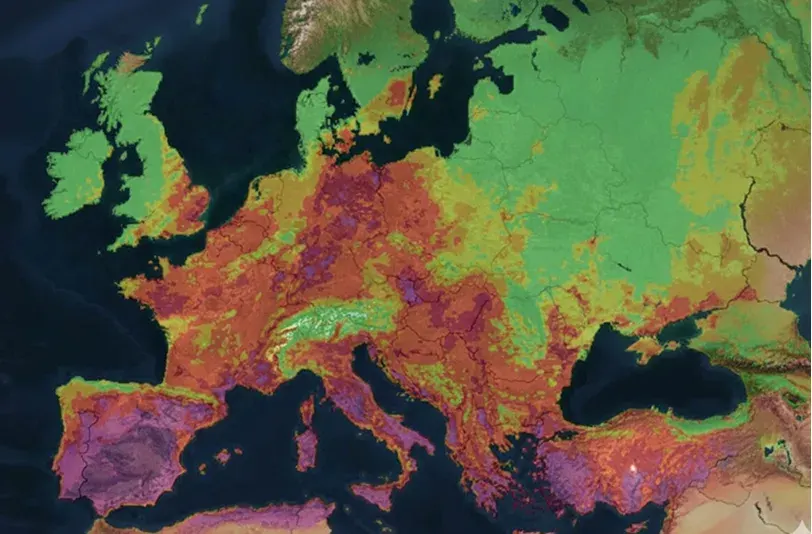
Extreme heat as a systemic risk: Europe's 2026 heatwave
An evidence-led analysis of how extreme heat can propagate across assets, infrastructure, communities and economic activity.
Aresbank: Physical climate risk across the banking book
A practical case study of portfolio-level physical climate-risk assessment for an international banking book.